What Is SEO? What Is GEO? The Simplest Explanation for Beginners
G
GnurtFull-stack developer
7 min read
In this article
If you are wondering what is SEO and GEO, here is the simplest explanation: SEO is how you optimise a website so it appears high in search results pages such as Google. GEO is how you optimise content so AI systems such as AI Overviews, ChatGPT or Perplexity choose it as a cited source when answering a question. Put simply: SEO helps readers find you, while GEO helps AI mention you.
This article explains both ideas in the simplest possible language, for beginners who have never done SEO.
What Is SEO?
SEO stands for Search Engine Optimization: optimising for search engines. When you type a question into Google, Google returns a list of web pages. SEO is all the work that helps your page appear in that list, and rank as high as possible.
SEO work usually revolves around three main things. First is content: an article must answer the question the reader is actually looking for. Second is technical: the website must load fast, display well on phones, and let Google read its content — much like keeping a website tidy by following a monthly WordPress maintenance checklist. Third is authority: other websites mention you and link to you — known as a backlink — like recommendations that help Google trust your page more.
The results of SEO are fairly easy to measure: keyword rankings, the number of clicks to the page, and traffic from search.
SEO helps your page appear in search results.
What Is GEO?
GEO stands for Generative Engine Optimization: optimising for generative AI answering engines. When you ask ChatGPT or Gemini, or read the AI Overviews summary on Google, you get a ready-written answer, together with the names of the sources cited. GEO is the work that helps your content be easily chosen as one of those sources.
The term GEO comes from a study by a team of authors from Princeton University and partner institutions, published in 2023 and presented at the KDD 2024 conference. In an experiment with about 10,000 questions, the researchers found that when source citations, statistics and expert quotations were added to content, the chance of that content appearing in an AI answer rose by up to about 40%. This is a result under experimental conditions, not a promise that every article will achieve that increase.
One important point to remember: GEO is not a separate set of tricks apart from SEO. According to Google, optimising for generative search is still optimising for the search experience, and therefore still SEO. GEO is just the name for the part of the work that helps content be cited by AI more easily, on top of the SEO foundation that is already in place.
GEO helps AI choose your content as a cited source.
What Do SEO and GEO Have in Common?
The biggest similarity is that both start with good content. Whether the reader is a person or an AI system, content that answers the question correctly, is written clearly and has evidence is always preferred.
Both also share a technical condition: a page must be indexed by Google and eligible to display a snippet before it has a chance to appear in Google’s AI features. In other words, if Google does not read and store your page, AI will also struggle to cite it.
Finally, both need clear structure: a title on topic, coherent subsections and trustworthy sources. A messy article struggles to rank high on Google, and is also hard for AI to summarise accurately.
How Do SEO and GEO Differ?
To see what is SEO and GEO in practice, the comparison table below summarises the core differences.
Criterion
SEO
GEO
Goal
Rank high on the results page and receive clicks
Be chosen by AI as a cited source in an answer
Where it appears
Google and Bing results pages
AI Overviews, AI Mode, ChatGPT, Perplexity, Gemini
What the user sees
A title, description and link to click
A ready-written answer, with the source name and link
How it is measured
Rankings, clicks and traffic via Search Console
How often it is cited and traffic from AI, harder to measure and needing additional tracking
Where Should a Beginner Start with SEO and GEO?
You do not need to learn every technique before starting. The following five tasks are enough for an article to be good for SEO and friendly to GEO.
First, answer the question directly in the first one or two sentences of the article. Do not open with a long history when the reader only needs a definition.
Second, use a title that matches the question readers often type, for example this article uses the very question “What is SEO? What is GEO?”.
Third, write short paragraphs, two to four sentences each, and use lists or tables when you need to compare. Both readers and AI find content easier to read when it is broken up clearly.
Fourth, state the source for every statistic and important claim. Only use statistics you can verify, and link to the original source instead of writing vaguely.
Fifth, come back and update the article when information changes, and state the date you last verified it. Fresh, accurate content has a better chance of being chosen than content left untouched for a long time.
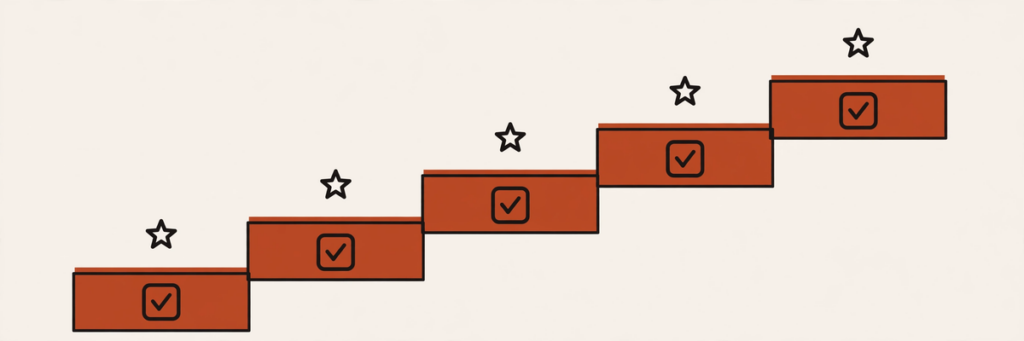
Five steps to start — one step at a time is enough.
Common Misunderstandings About SEO and GEO
The first misunderstanding: GEO will replace SEO. That is not the case. GEO rests on an SEO foundation: good content, a website that can be read, and authority. Dropping SEO to do only GEO is like decorating the front of a house while its foundations have not been built yet.
The second misunderstanding: creating an llms.txt file will get a website to the top of AI results. Google has said clearly that Google Search does not use llms.txt files or similar files, and keeping such a file neither helps nor harms rankings on Google. Do not spend time on tricks like this instead of writing good content.
The third misunderstanding: you must write a separate version for AI, quite different from the version for readers. Google advises against rewriting content specifically for AI. An article that is good for readers, with clear answers and full evidence, is already what AI needs in order to cite it.
Frequently Asked Questions
Does a beginner need to learn GEO right away?
Not in a hurry. Learn basic SEO first: choose the reader’s question correctly, write a clear answer, and keep the website working well. GEO is a natural extension once your content is already good.
Can a small website have a chance of being cited by AI?
Yes. In the Princeton team’s study, content ranked lower in search results also increased its chance of appearing when evidence such as citations and statistics was added. The chance is real, but nothing guarantees that a particular article will be chosen.
Does GEO need any special type of schema?
According to Google, no special schema is needed for generative search, and there is no separate type of markup that must be added. Schema you already have for rich results is still useful, but it is not a condition for being cited by AI.
Do SEO and GEO require paying for advertising?
No. This is organic optimisation: you improve content and the website so it can be found and cited. Advertising is a separate channel, paying for visibility, and it cannot replace this work.
Conclusion
Now that you know what is SEO and GEO, remember: SEO puts you on the search results page; GEO puts you inside an AI answer. The two may sound different, but both start from the same place: content that answers the question correctly, has verifiable evidence and is easy to read. Do that foundation well, and you have already covered most of the journey for both SEO and GEO.
Quick answer A backlink is a link from another website pointing to your website. Google treats each backlink like a recommendation: if a reputable, topically relevant page links to you, that is a signal that your content is worth referencing. But not all backlinks are equal. A good backlink can help Google discover a new...
What is Docker? Docker is an open platform that helps you package, ship, and run an app. An app runs in a separate environment called a container. In short, Docker helps an app run the same way on many different machines. Everything the app needs is packaged together. What Is Docker? According to Docker’s official...
AI code writing accounts for over 40% of pull requests on GitHub. An analysis of the latest figures and how developers and businesses can adapt to use AI effectively.